

4 - Testing different DI boxes

Intro
I was gifted a Palmer Pro DI a few holidays ago and never felt like it imparted a big enough difference from my old Behringder DI, so... I put them to the test.
Methodology
The following will be measured:
- The internal high impedance input of my SSL interface
- A Behringer DI600P
- and the Palmer01Pro
Repeatability is extremely important here, which is why a player playing the guitar shouldn’t be a part of tests like these - there’s WAY too much human intervention and subsequently (always) human error. A robot would help this, of course. Further, I didn’t want playing to be involved, as the measurement would inevitably be overly weighted around the fundamental frequencies of what was being played. (more in discussion)
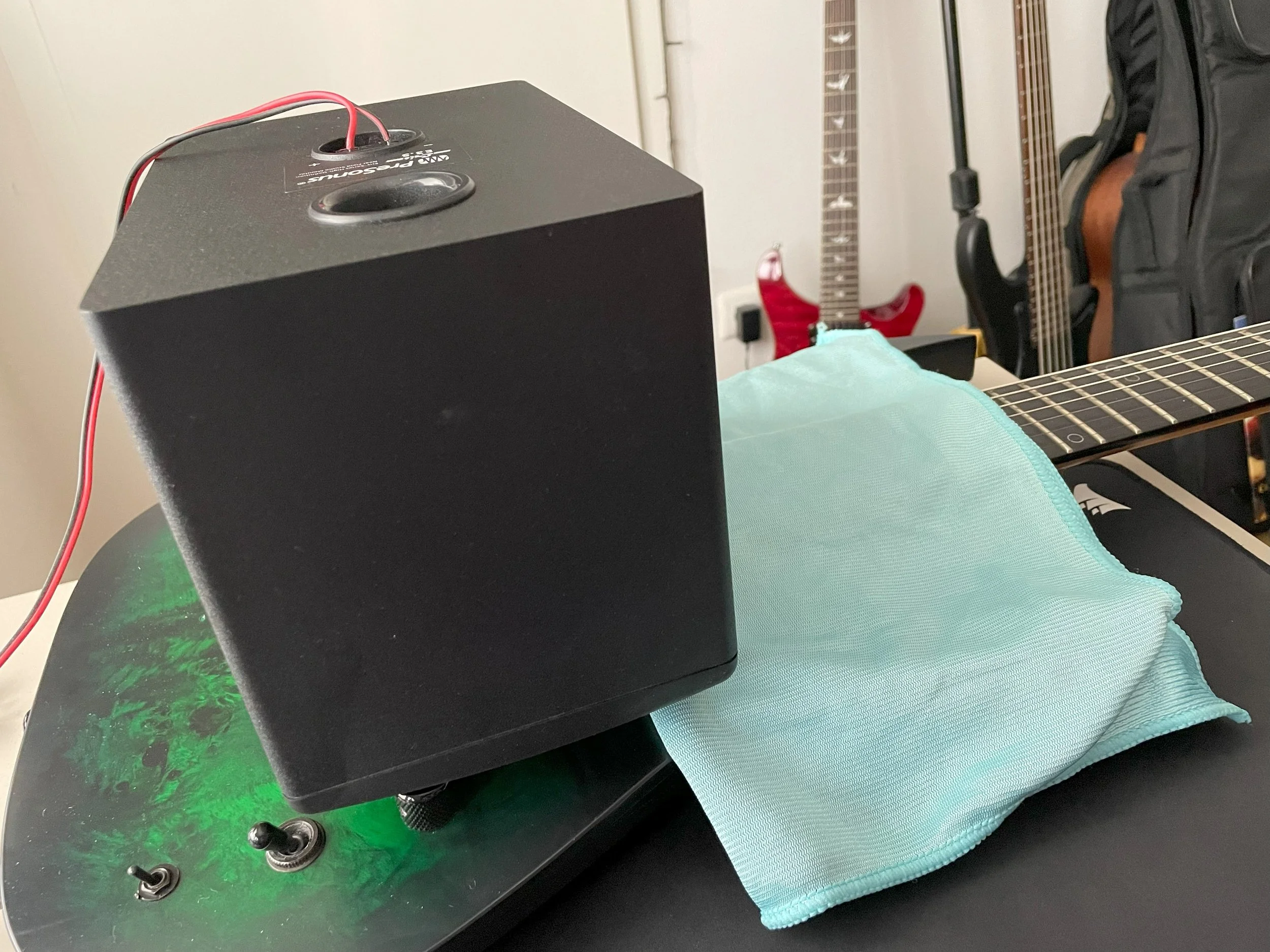
Since I don’t have a signal generator + oscilloscope, and it’s my personal belief that using one would be too “only replicable in a lab setting”, I’m placing a studio monitor up against the pick-up of the guitar and running 3x (averaged) 10-second, logarithmic, 20-20,000Hz sweeps through the speaker and pick-up, so that we actually get a “how the DI sounds after a guitar pick-up”, because this is all that matters. No one is ever going to be playing a signal generator through a DI….. wait a second… Jokes aside, I prefer this approach because this is how guitarists would actually use a DI. A pick-up will always be a part of electric guitar to DI, it shouldn’t be excluded by using lab equipment. I’d love for lab equipment to be involved, but that’s outside this post’s scope.
Since this peculiar methodology is a constant in the test, it will not affect the results.
Results
As a secondary test, to really make sure I did everything correctly, was carried out to feed the signal into the pick-ups with a headphone driver. Here I laid flat the ATH M50x headphone driver against the pick-up, and carried on as aforementioned.
Conclusion
Behringer has been absolutely killing it for the past decade in terms of quality. The SSL has a major 2,600Hz(-ish) bump which might actually sound great for contemporary metal guitar, so, good for me.
Discussion, further experimentation
Straight away, there are many issues - as with any testing of anything, really. I’m only outlining them for record keeping, in case anyone wants to tackle these, as they are far outside the scope of this post.
Important: I didn’t measure transient response. Ideally I’d do this with a waterfall-like plot (Example for a speaker), but this is something I’d need more time and skill to figure out how to reliably measure. Frequency response isn’t everything. You might have amazing flat monitors, but if it takes 100ms for the high range to get there, it’ll never sound flat, but it will measure as flat.
As amazing of a bargain as a Presonus Eris is, it’s not an ideal candidate for this due to its not-so-flat frequency response (Note: +/- 4dB is amazing for a <100€ set of monitors), though still flatter than any Hi-Fi speaker, so I’ll forcefully take a win there.
Further, HERE are some user-made frequency responses that suggest that turning off the tweeter would improve the flatness. Since we are only using the main driver to feed the signal into the pick-up, we’re already one step ahead there. Yay, another win.What if the pick-up’s ability to pick up electromagnetic waves were directional, and so the same phenomenon were to occur as with the proximity effect when using directional microphones?
Is the frequency response of a speaker going into a pick-up really a good analog of what an electromagnetic pick-up might hear? Is it even picking up the sound waves from the speaker, or is it actually picking up the electromagnetic field created by the speaker coil? This is a really important distinction because the speaker is sonically flat (+/-4 dB is relatively flat) while the electromagnetic fluctuations might not be(?) More research needed - probably with the involvement of at least one actual engineer (MSc).
Further to the stipulation that I didn’t want a guitar player to be involved in testing. Yes, I think that measuring a player would overly weigh the measurement to the intensity (dynamics), possibly including potential harmonic distortion, as well as the fundamental’s frequency range the person would be playing, but maybe taking a long term average would help if the person played low register chug riffs, medium register and full chords, and higher register dyads/solo-ing.
Further to this, it would all have to be done on new strings, per test. Again, budget. Capitalism, get away from my friend Science.